

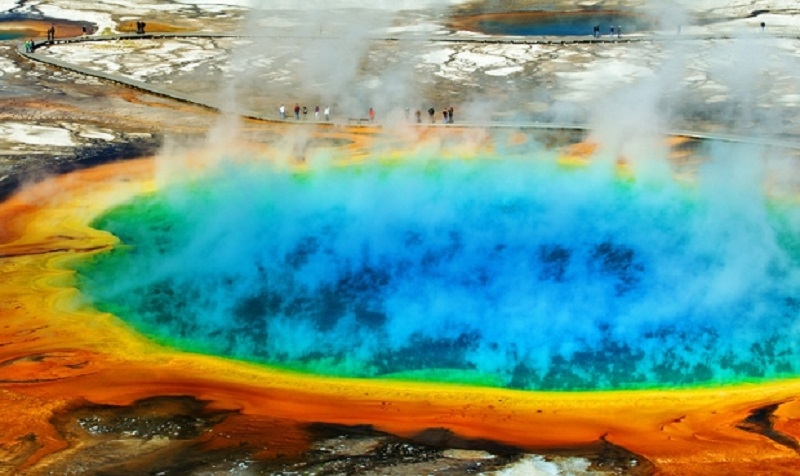
The Grand Prismatic Spring is different. People often visit a place, and after a while, they forget about it. But this place will be engraved in your heart forever. The Grand Prismatic Spring is inside Yellowstone National Park. People come from around the world to see this big pool of hot water. The Grand Prismatic Spring has colors like blue, orange, yellow, and green. That is why the Grand Prismatic Spring is something that people like to take pictures of when they're in the park.
For visitors flying into Wyoming, the Grand Prismatic Spring is often near the top of the itinerary. However, Wyoming offers different guides and tips for every season. The place is visually stunning and is a powerful example of the geothermal forces that continue shaping the landscape. In the further section of the article, we will now explore what it is, why it looks the way it does, and how hot it really gets, making the experience even more meaningful.
The Grand Prismatic Spring is the largest hot spring in the United States and one of the largest in the world. It is spread across 370 feet and has a reach of more than 120 feet. The spring naturally dominates the Midway Geyser Basin area of Yellowstone. Unlike erupting geysers, this spring doesn’t explode into the air. Instead, it continuously bubbles and releases steam as heated water rises from deep beneath the Earth’s surface.
The spring is formed when rain and snowmelt seep underground, and it is here that they are heated by magma far below. Now, the heated water then resurfaces, carrying minerals and creating the massive pool visitors see today. Simply, by standing beside it, one can actually feel the warmth radiating into the air. A quiet but constant reminder that Yellowstone sits at the top of one of the most active geothermal systems in the world.
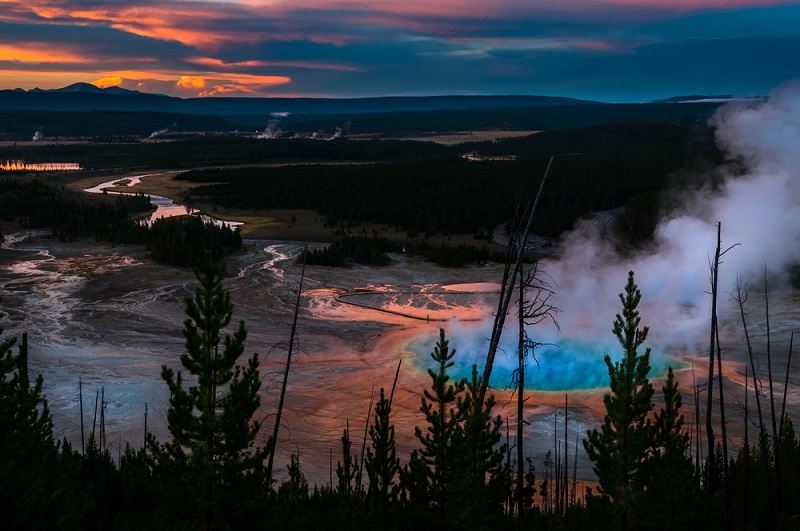
The Grand Prismatic Spring is colorful, and it is made colorful by microscopic organisms called thermophiles, heat-loving bacteria. It thrives in extreme temperatures. Moreover, the color is also the addition of minerals from the natural rocks and related elements. These microorganisms grow in layers around the edges of the spring, and each type produces different pigments.
At the center of the spring, where the water is hottest, the temperature is too extreme for most life to survive. The area appears to be deep blue because of the clarity of the water and the way it reflects sunlight. As the water cools moving outward, different thermophiles flourish, producing bands of orange, yellow, green, and even red tones. Interestingly, the colors can shift slightly depending on the season. During warmer months, increased microbial activity can make the outer rings appear more vibrant. This living ecosystem is what gives the Grand Prismatic Spring its signature rainbow effect.
The Grand Prismatic Spring temperature plays a crucial role in both its appearance and its ecosystem. The middle of the water has a temperature around 160°F (70°C). Simply by looking at it, it might seem that the spring water is not hot, but as it doesn't boil vigorously but with a touch of unconsciousness, the water temperature is so high that it is enough to burn your skin. The heat originates from Yellowstone’s volcanic activity deep underground.
As the water flows outward from the center, the water gradually cools down in temperature. These temperature shifts create distinct zones where various types of thermophilic bacteria stand a chance to survive. It is the heat fluctuation that contributes to the colorful rings.
As a result of these extreme temperatures, visitors are advised to remain on their designated boardwalks. It is crucial to know that the ground surrounding geothermal features can be thin and unstable, with scalding water just beneath the surface. Safety guidelines are strictly enforced to protect both visitors and the fragile environment.
Yellowstone is filled with geysers, hot springs, and dramatic landscapes, yet the Grand Prismatic Spring consistently ranks among the most admired attractions. On platforms like Tripadvisor, travelers frequently describe it as breathtaking and unforgettable.
Visitors are often attracted to the Grand Prismatic Spring due to its accessibility. Tourists can walk along boardwalks that provide close views of the steaming water. People can also opt for a striking perspective; the nearby overlook trail offers a panoramic view where the entire color spectrum becomes visible from above.
The recent visitors explain that lighting is a game-changer and mood enhancer for the entire spring experience. Midday sunlight often brings out. The richest colors, while cooler mornings create dramatic steam effects. The Grand Prismatic Spring has no time constraint to experience its relaxing and medicinal properties. The spring feels powerful and alive, a vivid reminder of the geothermal forces shaping Wyoming. For many travelers arriving through Wyoming’s regional airports, this iconic landmark becomes one of the highlights of their journey.
The Grand Prismatic Spring is really something in Yellowstone National Park. It is a system that is alive and working, shaped by a lot of heat and tiny living things. When you learn about what makes the Grand Prismatic Spring, well, spring, and why it has many colors, you start to appreciate it even more. The temperature of the spring also plays a role in how it looks. If you are going through Wyoming, you should see the Grand Prismatic Spring for yourself. It is an experience that you will not forget. The Grand Prismatic Spring is definitely worth visiting.
Learn More: Guide to Experience the Finest Wyoming Winter Vacations
No. The water temperature is around 160°F, and swimming is strictly prohibited for safety reasons.
Norris Geyser Basin contains some of the hottest springs in the park, often reaching boiling temperatures.
Midday is usually best, when sunlight enhances the colors and steam is less likely to block the view.
No. Visitors must stay on boardwalks due to unstable ground and extreme heat.
Yes. Thermophilic bacteria live around the edges and create the vibrant colors.
This content was created by AI